Aprende, juega y crece profesionalmente en el sector agroalimentario. En AGROSOCIAL apostamos por una formación práctica, flexible y adaptada a las necesidades del mundo rural. Aquí encontrarás cursos online en distintos niveles sobre financiación, transformación digital, sostenibilidad y alianzas estratégicas, además de experiencias formativas basadas en juegos.
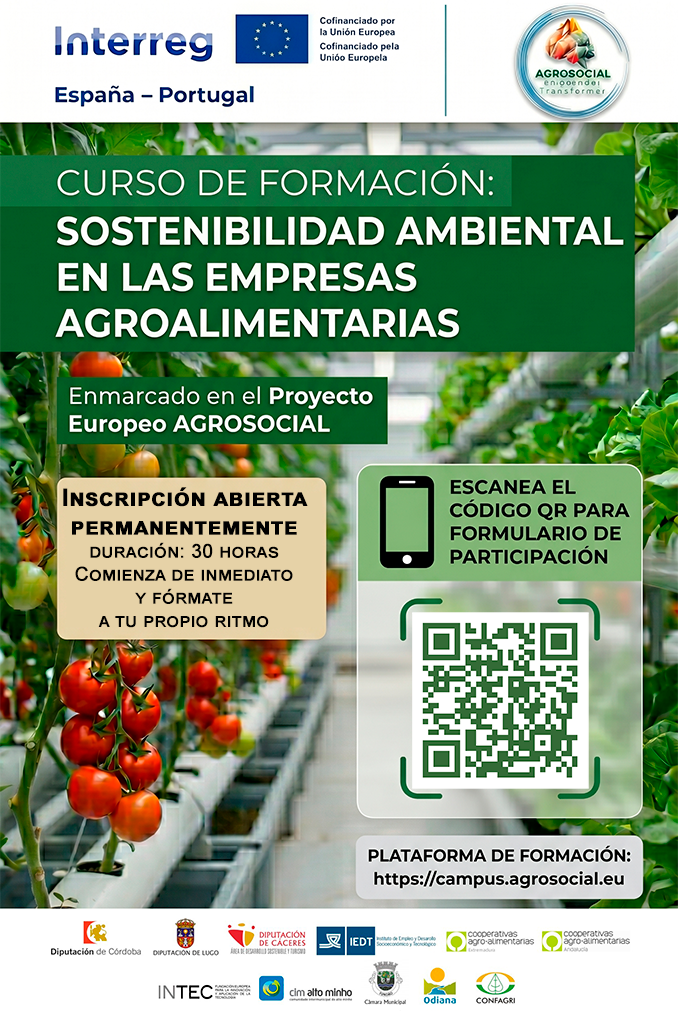 |
Descripción: aprende a identificar áreas de mejora ambiental en tu empresa y aplica herramientas y recursos para avanzar hacia una producción más sostenible en el sector agroalimentario del entorno rural transfronterizo.
- Número de horas: 30.
- Modalidad: Flexible / online
Contenido
Módulo 1: Soluciones basadas en la naturaleza para mejorar la sostenibilidad y la gestión del agua en explotaciones agrícolas
- Qué son las SBN: definición, enfoque y beneficios.
- Tipos de SBN en el ámbito agrícola.
- Manejo del suelo y gestión del agua de lluvia.
- Prevención de la erosión y técnicas para mejorar la infiltración.
- Incremento de la biodiversidad del suelo.
- Riego y fertilización racional.
- Resiliencia de cultivos ante olas de calor, sequías e inundaciones.
- Oportunidades de implantación de SBN y relación con la PAC.
- Análisis coste/beneficio de implantación de SBN.
Módulo 2: Sostenibilidad de los sistemas ganaderos
- Interacción entre las dimensiones medioambiental, social y económica.
- Manejo de las explotaciones desde el punto de vista de la sostenibilidad ambiental.
- Uso de razas y genotipos autóctonos.
- Empleo óptimo de insumos en las explotaciones ganaderas.
- Gestión de residuos, paisaje y responsabilidad medioambiental.
- Sostenibilidad interna: futuro de las granjas y relevo generacional.
- Respuestas a las demandas cambiantes de la sociedad.
- Factores que mejoran la rentabilidad: nutrición, sanidad, zootecnia, bioseguridad, ambiente y mano de obra.
- Mejora de la eficiencia productiva y programas de gestión sostenible.
- Indicadores para la evaluación de la sostenibilidad económica.
Módulo 3: Gestão e valorização de resíduos agropecuários e agroindustriais
- Análisis del ciclo del carbono y disminución de emisiones de CO2
- Economía circular: de subproducto a nuevo producto con valor.
- El compostaje como modelo de gestión.
- Gestión del ciclo del carbono a nivel de explotación y de industria transformadora.
- Uso de compost en explotaciones agrarias.
- Incremento de la salud de los suelos agrícolas: carbono, compactación, nutrición y biodiversidad.
 |
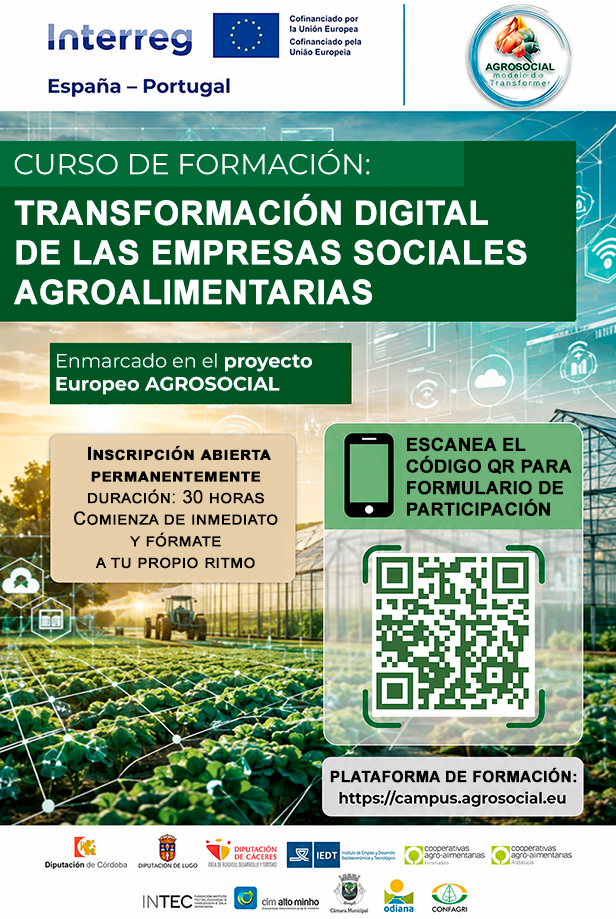 |
Descripción: conoce cómo la digitalización de los procesos productivos, de gestión y comercialización puede mejorar la eficiencia y rentabilidad de tu empresa social agroalimentaria. Incluye buenas prácticas y casos de éxito reales.
- Número de horas: 30.
- Modalidad: Flexible / online
Contenido
Modulo 1: Transformación digital en la economía social agroalimentaria.
- Unidad 1. Introducción y contexto.
- Unidad 2. Introducción a la transformación digital.
- Unidad 3. Retos y oportunidades para cooperativas y entidades de la economía social.
- Unidad 4. Elaboración de un plan para la transformación digital, paso a paso.
- Unidad 5. Herramientas básicas para iniciar la transformación digital.
Módulo 2: Herramientas digitales para la gestión y comercialización en el sector agroalimentario.
- Unidad 1. Introducción y contexto.
- Unidad 2. Digitalización de procesos internos: gestión, administración y producción.
- Unidad 3. Software de gestión agrícola y trazabilidad.
- Unidad 4. Comercialización y venta online de productos agroalimentarios.
- Unidad 5. Herramientas de inteligencia artificial y aplicaciones móviles para el sector.
Módulo 3: Comunicación, marketing digital y sostenibilidad digital.
- Unidad 1. Introducción y contexto.
- Unidad 2. Herramientas para la comunicación online: identidad digital, portal web y redes sociales.
- Unidad 3. Uso de redes sociales y otros canales digitales para visibilizar productos y valores.
- Unidad 4. Herramientas de bajo coste para la comunicación digital.
- Unidad 5. Capacitación digital en la nube: opciones para continuar el proceso de digitalización.
|
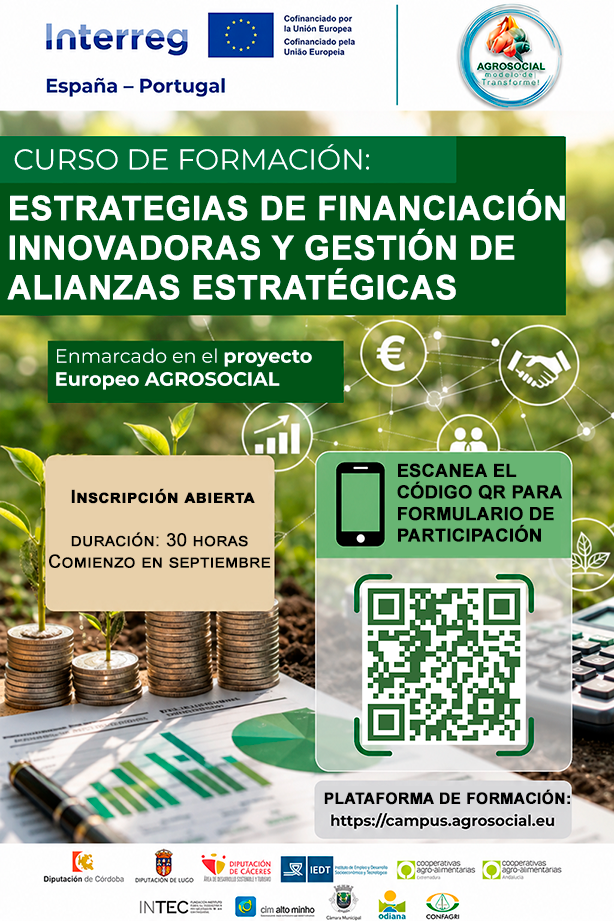 |
Curso 3: Estrategias de financiación innovadoras y gestión de alianzas estratégicas
Descripción: descubre oportunidades de financiación y recursos disponibles en el espacio transfronterizo. Aprende a establecer alianzas estratégicas que refuercen tu proyecto agroalimentario en el marco de la economía social.
- Número de horas: 30.
- Modalidad: Flexible / online
Contenido
Módulo 1: Estrategias Innovadoras de Gestión de Empresas Cooperativas
- Unidad 1. Introducción a la gestión cooperativa: valores, estructuras y desafíos actuales
- Unidad 2. Emprendimiento Social e Innovación Social
- Unidad 3. Liderazgo colaborativo y gestión participativa
- Unidad 4. Marketing y Comunicación
Módulo 2: Alianzas Estratégicas y Redes de Cooperación
- Unidad 1. Gestión Estratégica e Sostenibilidad
- Unidad 2. Alianzas Estratégicas: Concepto, Tipos, Beneficios y Riesgos
- Unidad 3. Planificación y estructuración de Alianzas Estratégicas
- Unidad 4. Gestión de redes e intercooperación
Módulo 3: Gestión Financiera, Ética y Responsabilidad Social y Evaluación de Impacto Social
- Unidad 1. Gestión financiera cooperativa
- Unidad 2. Ética y responsabilidad social
- Unidad 3. Evaluación de impacto social
|
Este proyecto está cofinanciado por Unión
Europea a través del Programa Interreg España-Portugal (POCTEP)
2021-2027. / Este projeto é
cofinanciado pela União Europeia através do Programa Interreg
Espanha-Portugal (POCTEP) 2021-2027. / This project is co-financed by the European Union through the
Interreg Spain–Portugal Programme (POCTEP) 2021–2027.
El contenido original de este sitio web ha sido desarrollado en español. La versión en portugués ha sido realizada por traductores profesionales para garantizar la máxima fidelidad. La versión en inglés ha sido generada mediante herramientas de inteligencia artificial para facilitar la comprensión, por lo que podría contener imprecisiones. / O conteúdo original deste sítio web foi desenvolvido em espanhol. A versão em português foi realizada por tradutores profissionais para garantir a máxima fidelidade. A versão em inglês foi gerada através de ferramentas de inteligência artificial para facilitar a compreensão, pelo que poderá conter imprecisões.
/ The original content of this site is in Spanish. The Portuguese translation was performed by professional translators to guarantee full fidelity. Please note that the English version was generated by artificial intelligence to facilitate general understanding and may contain errors or inaccuracies.


